


The Origins
to the Cittadini sisters
The Ursuline Sisters of Saint Jerome in Somasca trace their origins to the first half of the 19th century.
The Foundresses, the Cittadini sisters Caterina (1801-1857) and Giuditta (1803-1840), marked from their childhood by the experience of being orphans, after being welcomed into the orphanage of the Conventino in Bergamo and there obtaining their teaching diplomas, arrived in 1823 in the San Martino Valley, first in Calolziocorte, welcomed by their cousins Maria, Father Antonio, and Father Giovanni, priests, and then in Somasca, where Caterina was hired as a teacher in the municipal elementary school of Vercurago in the section located in the hamlet of Somasca. Caterina and Giuditta, also on the advice of Father Giuseppe Brena, prior of the orphanage of the Conventino, gradually matured the awareness of their calling to religious life: they desired to belong entirely to the Lord to dedicate themselves completely to the instruction and Christian education of youth as true mothers in Christ.
In 1826, with the help of their priest cousins, Caterina and Giuditta purchased a house in Somasca and started a school and a boarding school, of which Giuditta would be the director, for girls and young women from less affluent social classes and also for orphans, who at that time would not have had the opportunity to attend school, obtain a diploma, and receive a human, cultural, and spiritual education that would qualify the dignity and uniqueness of their being women in the family, society, and the Church.
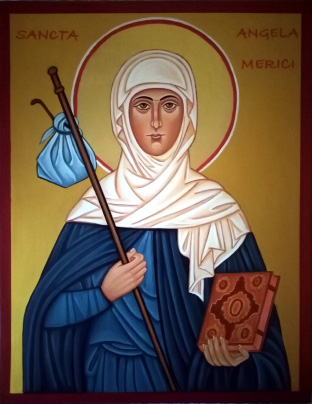
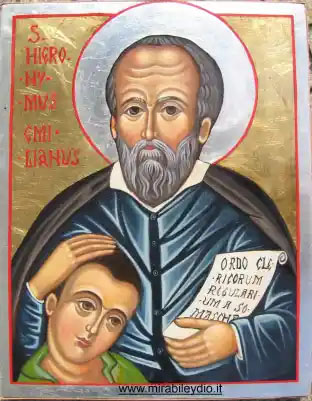
In the unfolding of their educational mission in “Him Alone,” Caterina and Giuditta understood that the identity of the religious Institute would be that of being Ursuline Sisters in the charismatic path of Saint Angela Merici (1474-1540), also allowing themselves to be guided by the example of the life of St. Jerome Emiliani, father of orphans, who had completed his work and mission in Somasca in 1537.
Angela Merici (1474-1540)
St. Angela gathered young women to train them in works of charity.
She then established, under the name of Saint Ursula, a female Order, entrusted with the task of seeking the perfection of life in the world and educating adolescents in the ways of the Lord.
Finally, in Brescia, she surrendered her soul to God.
No longer in cloisters, but in the world: this is the Cartesian axis of the spirituality of Saint Angela Merici who, with the testimony of her life, manages to give new form to the dignity of women. Born in Desenzano del Garda, in the province of Brescia, on March 21, 1474, Angela breathed a strong religious sense from an early age: in the evening, in fact, the family gathered around her father, Giovanni, to listen to him read the lives of the Saints. And it is precisely thanks to these readings that little Angela began to nurture a particular devotion to Saint Ursula, the noble young woman from Britannia martyred in the 4th century along with her companions, who would play a significant role in the maturation of her spirituality. At 15, Angela prematurely lost her sister and parents; she then moved to Salò, welcomed into the home of her maternal uncle. During those years, the desire arose in her to lead a more austere and penitential life, so much so that she chose to become a Franciscan tertiary. Five years later, upon the death of her uncle, the young woman returned to Desenzano where she dedicated herself to works of spiritual and corporal mercy, always accompanying manual work with prayer and recollection.
Returning to Italy in 1525, on the occasion of the Jubilee, Angela went on a pilgrimage to Rome, where she consolidated her charisma so much that Pope Clement VII proposed she remain in the “Eternal City.” But the young woman decided to return to Brescia, as she wanted to finally bring to life the “heavenly vision.” On November 25, 1535, therefore, together with twelve collaborators, she founded the “Company of the Dismissed of Saint Ursula” (“dismissed” because they lacked the traditional monastic habit), with an original Rule of life: to be outside the cloister to dedicate themselves to the instruction and education of young women, in obedience to the bishop and the Church.
It is a true revolution of grace: in the “Company,” in fact, every consecrated woman could sanctify her existence not within the confines of a convent, but by operating in the world, as in the original Church. In an era when women who could not be either wives or nuns were destined for marginalization, Angela offered them a new social condition, that of “consecrated virgins in the world,” capable of sanctifying themselves to sanctify the family and society.
It is a true revolution of grace: in the “Company,” in fact, every consecrated woman could sanctify her existence not within the confines of a convent, but by operating in the world, as in the original Church. In an era when women who could not be either wives or nuns were destined for marginalization, Angela offered them a new social condition, that of “consecrated virgins in the world,” capable of sanctifying themselves to sanctify the family and society.
Excerpt from “Dicastery for the Causes of Saints“
From the spiritual testament:
“I beseech you – it reads in her spiritual testament, intended for the Ursulines – to remember and keep engraved in your mind and heart all your daughters, one by one. And not only their names, but also their condition, character, and state, and everything about them. This will not be difficult for you if you embrace them with living charity. Engage with love and with a gentle and sweet hand, not imperiously and harshly, but in everything, you should be pleasant.” “Above all,” she concluded, “beware of wanting to obtain anything by force, because God has given everyone free will and does not want to force anyone, but only proposes and advises.”
Jerome Emiliani (1486-1537)
After a carefree youth, he converted to God and dedicated himself fully, along with the companions gathered with him, to all the wretched, especially orphans and the sick; this was the beginning of the Congregation of the Clerics Regular, known as the Somaschi, still predominantly engaged today in the Christian education of youth.
Universal patron of orphans and abandoned youth.
Jerome Emiliani, or more properly Miani, was born in Venice in 1486.
The fourth son of the fallen noble family of the Emilians, like all young Venetians of the 1500s, Jerome dreamed of a military career, also because it was the most lucrative. Information about his life before enlistment, which occurred in 1509, is very scarce; however, it is known that when he was about ten years old, his father committed suicide.
In 1511, during the siege of the Fortress of Castelnuovo di Quero, along the Piave, he was taken prisoner by the enemy, and the experience of detention, although it lasted just 30 days, changed him profoundly. In hunger, pain, and fear for his life, Jerome found the words to pray and directed his requests specifically to the Madonna, to whom he promised to convert in exchange for freedom. Once released, he found refuge in Treviso, but he did not forget the vow made to the Virgin and, entrusting himself to a priest and beginning to read the Bible, he started to change his heart.
The first opportunity Jerome had to test the new self was during the plague epidemic that struck Venice in 1528. With a group of volunteers, he roamed the city to bring comfort to the sick, to whom he made all his possessions available. Infected himself by the disease, he would emerge with a miraculous recovery. Thus began his path of charity, which would always be directed towards the most needy, starting with the poor, prostitutes, but especially orphans.
When his brother Luca died, leaving his three nephews orphaned, Jerome took charge of them, and it was there that he had the intuition of life: to establish an association that expressly took care of young people left without families, taking responsibility for their education.
Thus, in 1533 in Bergamo, the Company of the Servants of the Poor was born, committed to defending war orphans, the weakest and most defenseless among the last: for them, Jerome created a school of arts and crafts, alongside which he taught catechism following a method innovative for the time, which had as its fundamental program prayer and work, the cardinal principles that ennoble man.
The original Company would later become a Congregation, until in 1568, Pius V elevated it to an Order, whose religious would be called the Clerics Regular of Somasca, from the place that the Archbishop of Milan had entrusted to Jerome and from which everything had started. In the charism of the Somaschi, devotion to Mary, venerated as “Mater orphanorum.” Jerome, however, by this point, had already died of the plague in 1537.
Canonized in 1767, since 1928 he has been the Holy Patron of abandoned youth.
Excerpt from “Dicastery for the Causes of Saints“